- ian@etherintroductions.com
- 07795 275934
 Ether Introductions
Insurance Supply Chain Experts
Ether IntroductionsEther Introductions
We have undertaken extensive reviews and rate negotiations for legal services across all lines of

My journey in the insurance industry began as a graduate trainee loss adjuster, handling a wide array of domestic and commercial claims across East London. This foundational experience provided me with a granular understanding of the claims process from the ground up.
Over time, I transitioned into overseeing claims teams and building repair networks, culminating in a leadership role with responsibility for the claims supply chain at a global insurer. I have extensive experience in claims auditing and TPA (Third Party Administrator) management, including the creation and optimization of TPA models suited to Lloyd’s and the broader London market. My skillset includes negotiating legal services in the London market to deliver optimal value and results across complex, multi-jurisdictional claims. This unique career trajectory has given me a comprehensive, 360-degree perspective on the claims ecosystem—understanding not only claims management but also the intricate network of suppliers, partners, TPAs, and technologies that drive successful outcomes across the London insurance market. My expertise enables me to deliver tailored solutions and strategic value for Lloyd’s syndicates and London market participants operating in an evolving risk environment.
I don’t just understand claims; I understand the intricate network of suppliers, partners, and technologies that drive successful outcomes across multiple classes of business.
My experience spans the full spectrum of the insurance claims landscape.
Proud to have consulted for some of the biggest names in the insurance sector.






Let’s discuss how my experience can deliver value to your business. Whether you need strategic advice, project management, or procurement expertise, I’m here to help.

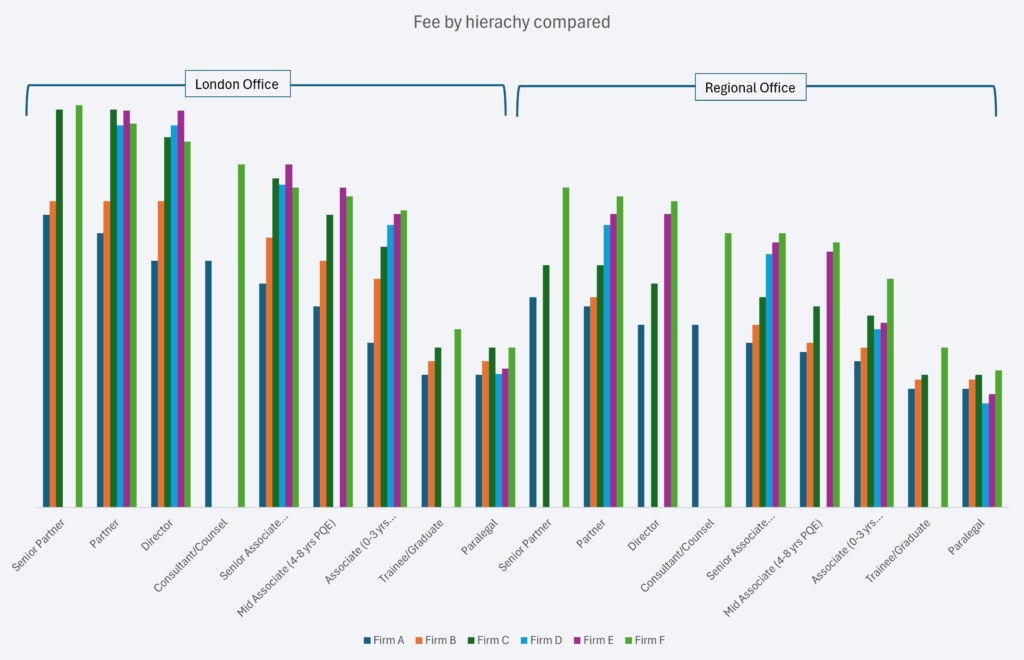
Starting with the basics – comparing different firms rates by fee hierarchy. This is done by lines of business and then separated out into different offices, namely London and then regional.
As can be seen there is a wide difference in rates by firms. And all firms offer markedly cheaper rates in regional hubs compared to London offices.
We have extensive rates for comparison, although at this stage it is not possible to provide meaningful insights without further data analysis.
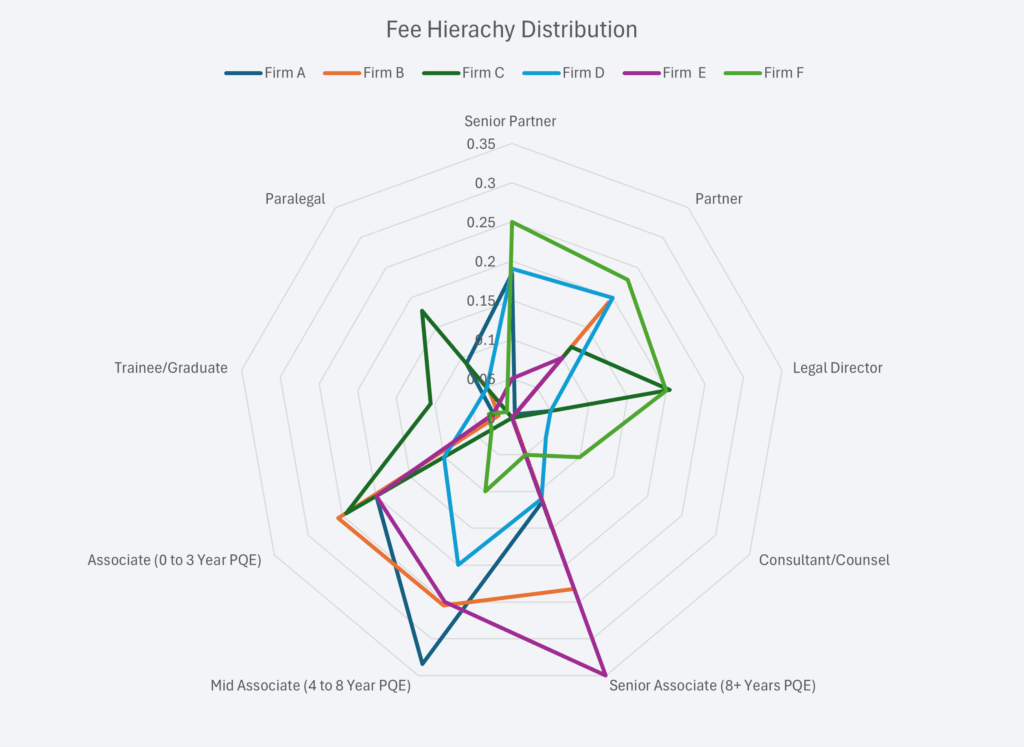
To get towards having a meaningful data set for comparison purposes, we first need to see where each firms fee distribution is.
As is evident in the data set, there is a marked difference between firms of which fee hierarchy is the most prevalent. Firm F is very heavily weighed towards the top 3 earners (Senior Partner, Partner and Director). Firms B and E are more weighted to the associate bandings.
This makes a big difference to the overall weighted fee per hour when comparing firms.
To obtain a true picture of the average fee per hour by firm, we undertake this process for both the London and Regional offices. We then apply a weighting to the usage of these offices, and arrive at a final blended rate per hour.
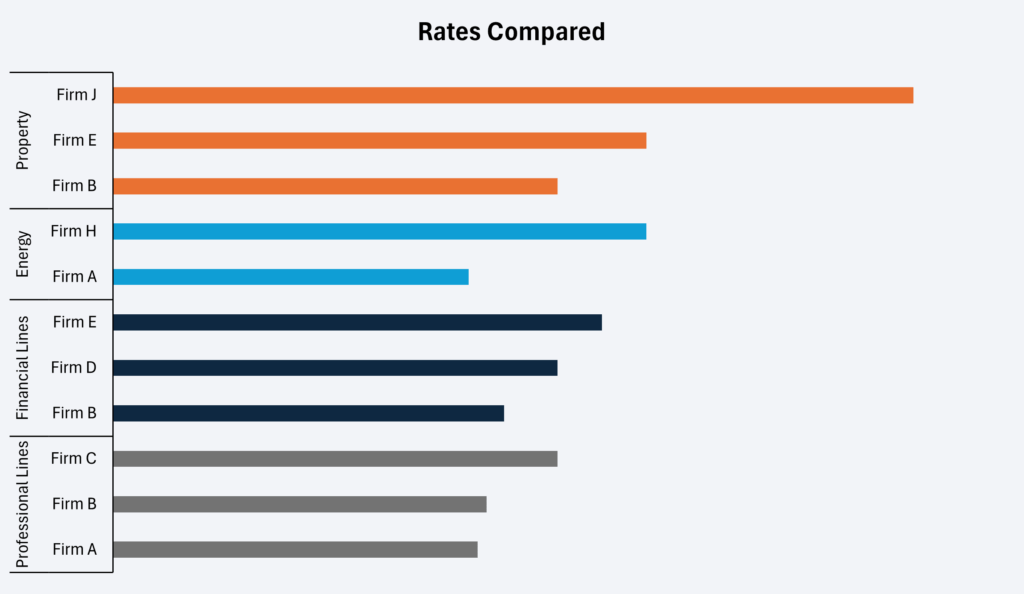
Hourly rates will vary by the Line of Business the matter will relate to. We compare all rates from an insurers panel, applying the blended average. By doing this we are able to compare true costs per hour across any panel firm.
Once we have collated the cost data we are able to immediately see the disparity in costs by firms. For example, on Property matters, is Firm J really worth the extra uplift on costs compared to Firms E and B? Often the answer is yes so the next stage is to quantify why that is.
In most cases though, the general feedback is that the panel firms are, to a lesser or greater degree, equal. In which case we adopt a two tier approach:
Comparing existing legal providers is a highly effective way to reduce costs within the panel. However, you don’t know how cost effective the panel is compared to the wider market.
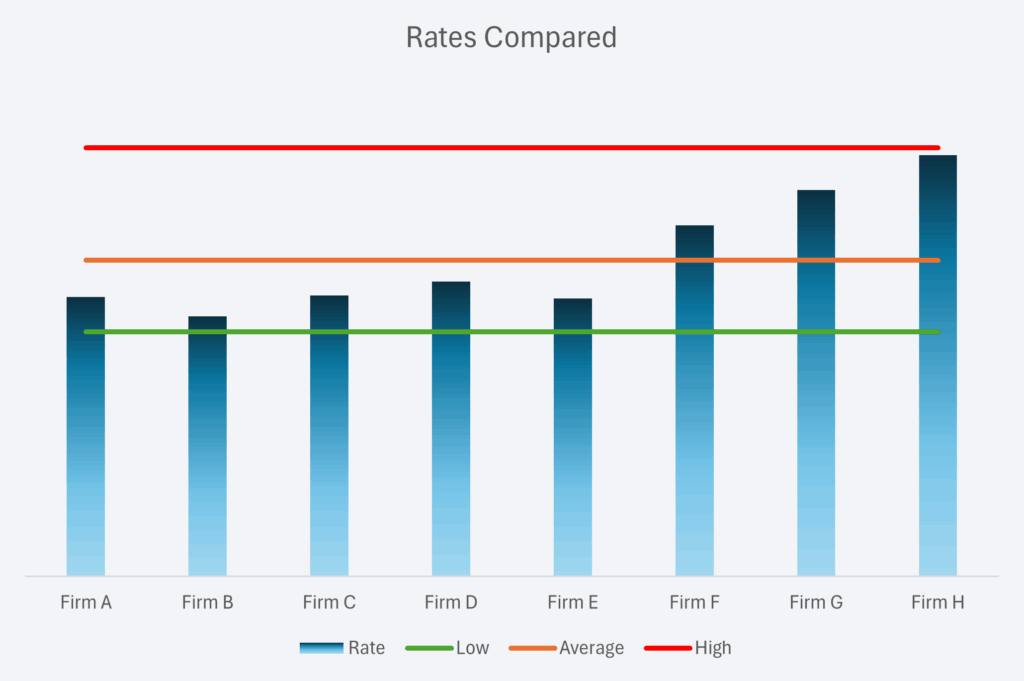
We have thousands of data points collected as a wider industry benchmarking. As such we are able to provide an insight into how your cost base compares to the wider market.
Whilst Firms A through E are all billing an average hourly fee below the market average, Firms F through H are comparatively high. Firm H is approaching the top rate found in the market.
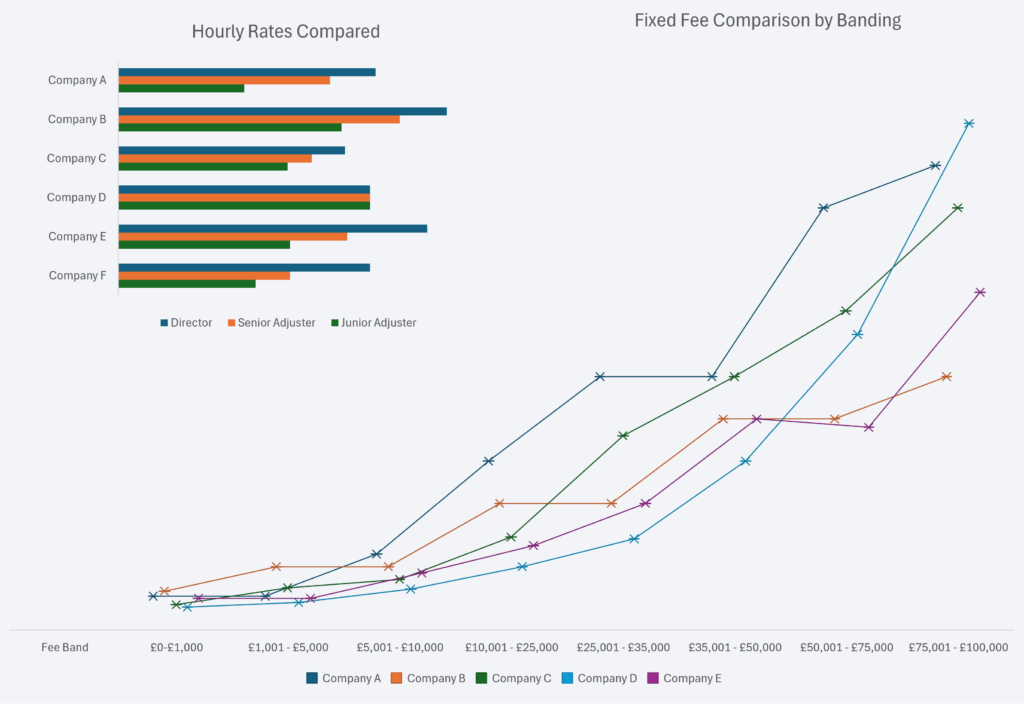
Starting with the basics – comparing different firms fees. This is done by lines of business and then applied by:
The key with banded rates is to understand where your typical claims settlement sits. This way you can compare the band(s) that are most frequent to your book.
We have multiple data sets and are able to advise on how competitive, or not, your negotiated fees are.
Comparing fees by bandings only shows a part of the picture.
Having undertaken an in depth audit for a leading UK insurer, we found that there was a large difference in average fees. This was despite their being very similar commercial terms.
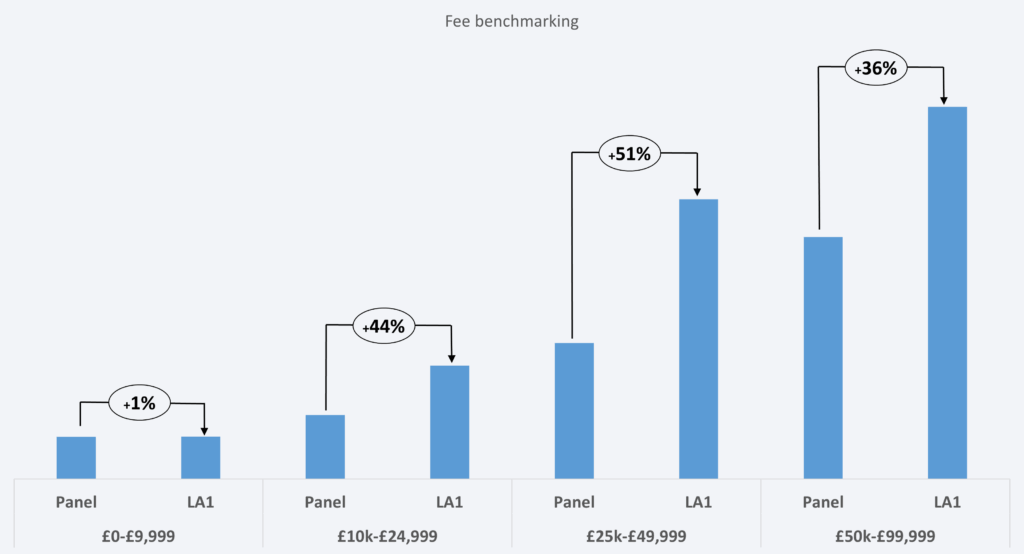
Firm LA1 was consistently billing more per settlement banding than the other panel firms. In the lower band (up to £10,000) there was no real disparity. In the two bands up to £50,000 however, there was a marked increase in fees.
Our findings showed that on lower value claims, most loss adjuster invoices were as per the fixed fees. At the next two bandings, LA1 was frequently requesting an hourly rate to be applied. This took the claim outside of the pre-agreed fixed fee. This made the average fee significantly higher than the panel average.
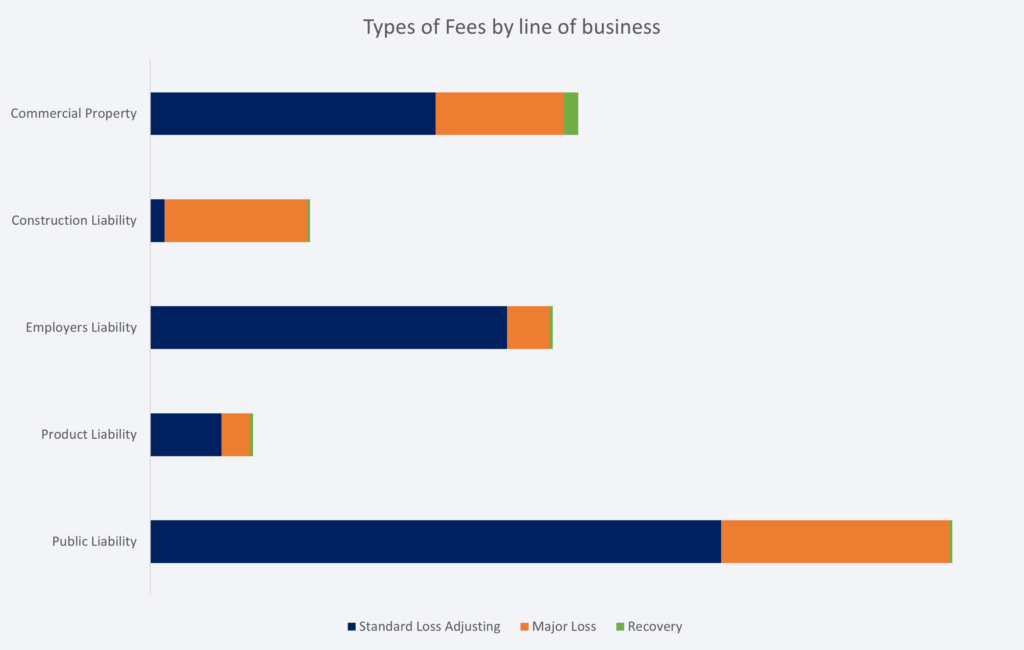
Service costs will naturally vary by line of business so it is vital when comparing average fees or total spend to do this by type.
For example, in a London market audit it was initially felt that the average fee claim settled was too high on Construction Liability claims. However, a data audit soon identified that the vast majority of claims required a major loss adjuster and therefore the application of hourly rates pushed up the average costs.
Conversely, commercial property average fees were the lowest as more claims were billed at the fixed fee bandings and at a recovery rate.
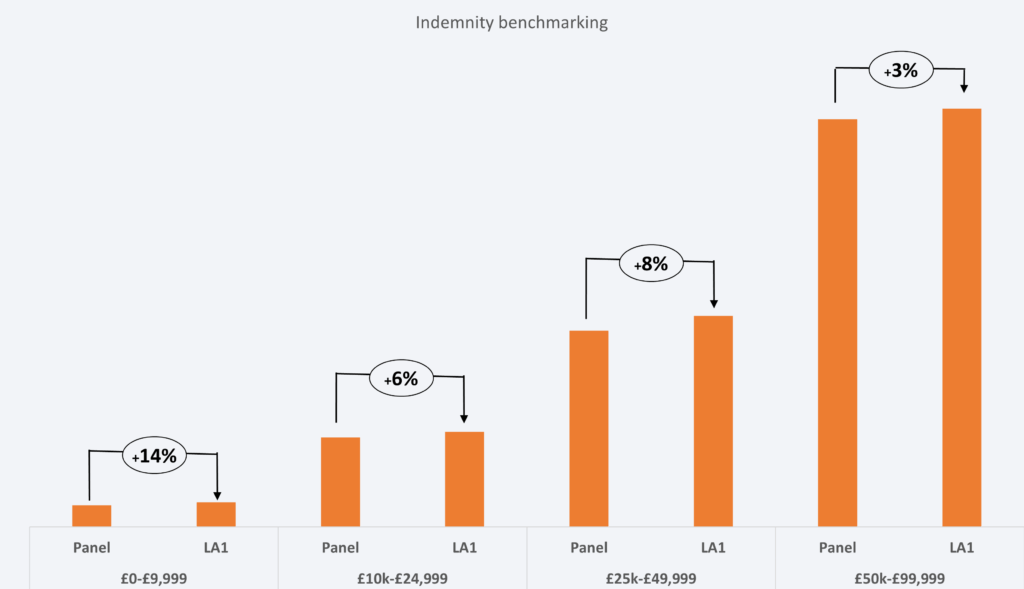
Fees are important but the biggest impact on the claims book is always going to be the indemnity spend. In the case of Loss Adjuster led claims it is ensuring that the panel firm is able to control costs in line with the policy terms and conditions.
In the case of firm LA1, when our audit showed their costs were higher than the panel average, they counter claimed that because of the quality of service, it still represented value for money.
Unfortunately when reviewing the claims outcomes, it became very clear that in fact the opposite was the case and the higher fee was matched by higher average settlement costs.
We generally find that TPA fees don’t self-fund; they won’t cover operational costs. As a consequence, the TPA function becomes a loss leader which can only operate at the fee levels they do if that function can feed another part of the business.
For example, we reviewed the TPA panel for a leading London syndicate’s US property book and found the following;
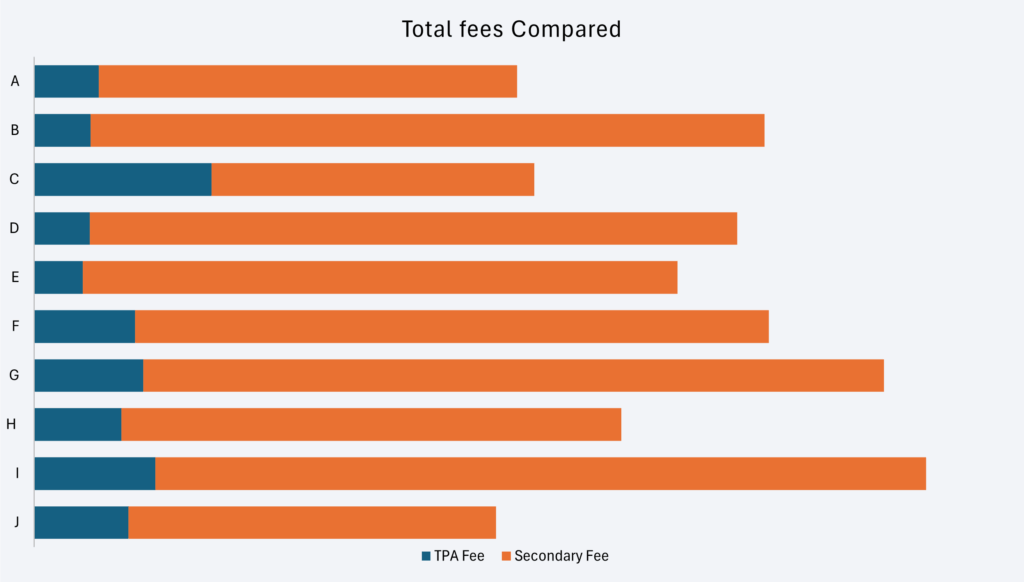
Taking 10 sets of TPA data which cover comparable lines of business, we can see that the secondary fee (loss adjuster or other owned service) is substantially more than the total TPA fee on its own.
Whilst a higher TPA fee can (Firm C) offset the need for higher secondary fees, that is not always the case (Firm I).
The key, as ever, is to be able to compare all aspects of associated fees to be able to provide accurate benchmark comparisons of costs.
Undertaking a full audit of a UK based TPA for a major insurance client, we soon discovered that their primary focus was revenue generation into the wider group.
On average, they were instructing their own companies 2.3 times for each TPA instruction they received. On a large number of instructions, up to 5 group companies were instructed.
The number of low value claims settled at desktop was minimal and secondary fees were spiralling out of control. As can be seen, the TPA fee element of total costs looked quite insignificant.


Fees are obviously only a small part of the overall claims spend. Indemnity, at least on most claims, will always be the higher proportion of total claims costs.
What we look for here is value for money. Larger claims incur larger fees, as do more complex claims even at a lower claims amount threshold.
So when we compare the total fees as a percentage of total claims costs (all fees + indemnity) we can start to draw comparisons between different TPA performances.
On the face of it, Firm E is providing good value for money, whereas Firm G really is not. There is of course a very important caveat to this assumption. If leakage is rampant then value for money will significantly drop. Equally, Firm J looks to be adding less value, but was achieving very strong indemnity controls and fraud detection rates.
It is not just about costs, but service too. When TPA’s instruct themselves it adds complexity and time delays to the claims duration.
Looking at a simplistic measure of indemnity spend vs elapsed days, it is evident that Firm H is taking too long to settle low value claims. In contrast Firms A and G are concluding claims in half that time.
Elapsed days are only one customer measure, but it is an important one.




An infographic mapping the intricate web of claims interconnections
The London Market claims process is a collaborative effort, orchestrated by several key entities, each with distinct responsibilities. Understanding these roles is crucial to navigating the claims journey. This diagram illustrates the primary participants and their fundamental interactions.
A claim’s journey through the London Market follows a structured, technology-enabled path. While complex claims have many nuances, this flowchart illustrates the typical process for a subscription market risk, highlighting key systems and agreement protocols that ensure efficiency.
Policyholder informs Broker, who submits the claim to the Lead Insurer via the Electronic Claim File (ECF) system.
Lead Insurer reviews the claim, assesses complexity, and appoints experts (Loss Adjusters, Lawyers, etc.) as needed.
Experts investigate the cause and value of the loss, reporting their findings back to the Insurer and Broker.
For subscription risks, agreement is streamlined. The Lloyd’s Claims Scheme or SCAP gives the Lead authority to agree the claim for following insurers.
Broker negotiates the final settlement with the Lead Insurer on behalf of the policyholder.
Funds are collected from all participating insurers via central market systems (e.g., DXC) and paid to the Broker for transfer to the policyholder.
The nature of the risk fundamentally shapes the claims process. Different lines of business place emphasis on different experts and interactions. Below is a comparison of how the claims ecosystem adapts to various specialty risks.
Claims are driven by physical damage. The process is dominated by on-site investigation to determine the cause and quantify the cost of reinstatement and lost income.
Key Players:
The Loss Adjuster’s report on damage and valuation is the central document driving the claim forward, especially for property damage. Forensic Accountants are vital for complex Business Interruption calculations.
Claims arise from allegations of professional error or negligence. The process is typically litigation-driven, focusing on legal defense strategy, coverage analysis, and expert witness testimony from the outset.
Key Players:
The immediate appointment of Legal Firms (Defense and Coverage Counsel) is the critical first step. Expert Witnesses specific to the profession involved are often crucial.
These claims are global, involving damage to vessels (Hull) or goods in transit (Cargo). Swift on-site assessment by technical experts (Surveyors) and understanding of maritime law are crucial.
Key Players:
Marine Surveyors provide initial damage assessments. Average Adjusters quantify complex claims like General Average. Maritime Lawyers and P&I Clubs handle liability aspects.
Cyber claims are a crisis response to events like data breaches or ransomware attacks. The focus is on immediate incident containment, forensic investigation, legal compliance, and managing reputational fallout.
Key Players:
The claim is a live incident response, managed by a panel of pre-approved specialists (Forensics, Breach Coach, PR, Negotiators) activated by the insurer, often coordinated by a TPA or specialized MGA.
Energy claims often involve high-value, high-complexity events (e.g., damage to rigs, pipelines, refineries). They require deep engineering, environmental, and contractual expertise to analyze cause, control loss, and plan remediation.
Key Players:
Highly specialized engineering consultants and environmental experts are central. Specialist Loss Adjusters coordinate the multi-faceted investigation and quantification.
“Insurance for insurers.” Claims are typically a B2B transaction based on the underlying claim paid by the ceding insurer. Data quality, accuracy of bordereaux, and treaty/facultative wording interpretation are paramount.
Key Players:
The claim is a data-driven process, relying on the quality of claims bordereaux from the Cedent. Reinsurers may conduct claims audits for large or unusual losses. The Reinsurance Broker facilitates communication and settlement.
The London Market claims environment is not static. It is constantly evolving under the pressure of external trends and internal modernization efforts. These factors are reshaping relationships and demanding greater agility from all participants.
The chart below represents the perceived impact level of key trends on the London Market claims process, based on the emphasis within industry analysis. Higher values indicate a greater influence on changing operational dynamics and strategic priorities.
Inflation and the push for Digital Transformation (Blueprint Two) are exerting the most significant pressure, fundamentally altering claims costs and operational workflows. Climate change drives loss frequency and severity, while talent shortages pose a long-term strategic risk to the market’s expertise-driven model.







Managing claims supply spend effectively is crucial. But before you can optimize, you need to


